
Neon Lines: Tap & Clear
Chillapex StudioCasual
4.9479.00 Reviews
- Version
- 1.13.0
- Installs
- 500.00K
- Age Rating
- Everyone
Screenshots

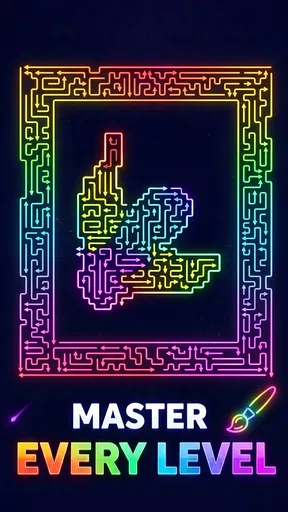


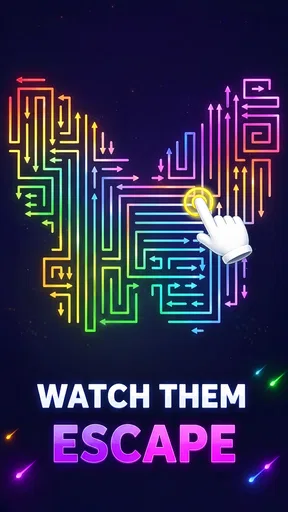

Our Review of Neon Lines: Tap & Clear
 Analysis by Appyee
Neon Lines: Tap & Clear is the kind of casual game I open when I want a short logic break rather than a full gaming session. Its central idea is simple: I swipe arrows through a neon maze and try to clear the lines without creating a blockage. That sounds easy until the board starts asking me to think about order, direction, and the space each move will leave behind. The appeal is not a large collection of systems; it is the small, focused challenge created by one clear interaction.
After spending time with it, I see the game as a good fit for players who enjoy compact puzzles that can be understood quickly but still punish careless decisions. Chillapex Studio keeps the presentation centered on the board, so the visual identity supports the puzzle instead of distracting from it. The store summary describes the experience as swiping arrows to solve logic mazes, and that is a fair description, but it does not quite capture the important part: the real challenge is planning a safe sequence before I commit to a swipe.
Why the arrow-swiping idea works
The strongest capability here is the direct relationship between a swipe and the board’s changing possibilities. I am not merely matching colors or tapping whichever object looks available. Each arrow suggests a route, and clearing it can either open the puzzle or make the remaining arrangement harder to read. That makes every move feel useful, even when the board itself is visually minimal.
I like this design because it gives the game a low learning curve without making the decisions meaningless. A new player can understand the basic gesture almost immediately, while a more experienced player starts looking for dependencies: which arrow is blocking another, which path needs to remain open, and whether a tempting move will remove the only practical route for the next piece. The game’s casual category is accurate, but “casual” does not mean mindless in this case.
The neon presentation also has a practical effect. Bright lines and arrows make the active elements easy to distinguish at a glance, which matters when I am playing in a short break and do not want to study a complicated interface. At the same time, the glow can make a crowded board feel busier than a plain puzzle grid. I found that I played more carefully when several directions crossed visually, because the decoration made it important to pause and identify the actual route rather than react to the brightest shape.
The key skill is not swiping quickly; it is preserving options. That is the difference between this game and a simple reflex title. If I treat every available arrow as equally safe, I can make a move that looks productive but leaves the rest of the maze in an awkward state. If I first identify the pieces with the fewest possible routes, the board becomes easier to reason about.
How a typical puzzle unfolds in practice
My usual approach is to begin with observation rather than action. I scan the board for arrows that appear to have a direct, unobstructed path and then check whether moving one would interfere with another. This takes only a moment on a simple layout, but it becomes the difference between a clean solution and a sequence of uncertain swipes on a denser one.
The first move often acts like a test of the board’s logic. If an arrow clears cleanly, I gain space and a better view of the remaining arrangement. If it does not, I have learned that the apparent route was not as straightforward as it looked. This makes the game feel closer to a small spatial reasoning exercise than to a conventional tap-to-score pastime.
I also found it useful to work from the outside inward. Arrows near the edge are often easier to evaluate because they have fewer surrounding elements competing for attention. That is not a universal solution, so I do not follow it blindly, but it gives me a reliable starting point when the board initially looks confusing. On other layouts, the correct first move is the arrow that blocks several others, even if it is not the easiest one to clear.
One practical tip is to avoid swiping merely because an arrow is available. Before moving, I ask myself what the board will look like afterward. Will the next arrow have a visible route? Have I opened a useful lane, or have I simply removed one object while leaving the real obstruction untouched? This habit reduces random play and makes the game more satisfying because successful clears feel earned through a recognizable plan.
Another useful habit is to separate visual brightness from logical importance. Neon graphics naturally draw the eye toward vivid elements, but the most important arrow may be the one that seems least prominent. I get better results when I trace possible paths with my eyes and consider the order of removal. This is especially helpful during a quick session when I am tempted to act before fully reading the board.
The controls are approachable for touch play. A swipe feels more natural here than selecting a direction from a menu, and the gesture keeps the focus on the physical shape of the maze. Still, touch interaction has a small weakness: on a compact screen, an imprecise gesture can feel less deliberate than the thought behind it. I recommend using a comfortable grip and making short, clear swipes instead of dragging across the entire display.
The best everyday use for this game
The strongest scenario for Neon Lines: Tap & Clear is a short waiting period: a commute stop, a coffee break, or the few minutes before an appointment. I can start a puzzle without learning a story, managing a character, or remembering a complicated set of rules. The game gives my attention something specific to do, and the arrow mechanic is understandable enough that I can return after a pause without needing a tutorial refresher.
For example, if I have several minutes before leaving home, I can play one focused round while waiting for something to finish. I begin by looking for the most constrained route, clear the obvious obstruction, and then reassess the board after each swipe. This is a better fit for my routine than a game that demands a long uninterrupted session. The puzzle can occupy a small window of time without asking me to make a large commitment.
It also works well when I want a screen activity that feels calmer than an action game. There is pressure from making the wrong decision, but the pressure comes from reasoning rather than speed. That makes it suitable for players who like the satisfaction of untangling a problem but do not want rapid tapping or constant visual movement.
I would not choose it when I am looking for social play, a narrative journey, or a deep progression system. Its appeal comes from the board in front of me, not from a cast of characters or a large world to explore. Players who need frequent novelty through story events, competitive matches, or elaborate customization may find the focused format too narrow.
The game is free and carries an Everyone content rating, which makes it easy to recommend as a straightforward puzzle option for a broad audience. Parents should still decide whether any screen game fits a child’s routine, but the basic concept is accessible enough for younger players who can manage touch controls and enjoy visual logic. Adults who want a quick mental reset can appreciate it for the same reason.
Where it differs from familiar casual puzzle alternatives
Compared with match-three games, this one asks me to think about movement and sequencing instead of creating groups from a changing supply of pieces. There is less emphasis on luck or rapid pattern recognition and more on reading the fixed arrangement in front of me. That makes it a better choice when I want to feel responsible for the solution rather than wait for a favorable combination.
It also differs from traditional grid puzzles that rely on numbers or symbols. The arrows communicate direction visually, so I can understand the board without translating every element into a written rule. The trade-off is that visual interpretation becomes more important. Someone who prefers explicit numerical logic may find a numbered puzzle more precise, while someone who enjoys spatial relationships may connect with the neon layout faster.
Against endless runners or reflex-based casual games, Neon Lines: Tap & Clear is noticeably more deliberate. I am not trying to react before a timer or avoid hazards moving toward me. The main tension comes from committing to a sequence. That makes it useful for a quiet break, but less suitable when I want energy, speed, or a strong sense of physical momentum.
It is also more focused than many casual games that combine puzzles with collecting, decorating, or long-term upgrades. That focus is a strength because the interface stays understandable. It is a limitation because players who enjoy unlocking layers of content may feel that the core mechanic has to carry the entire experience. For me, the cleaner structure is welcome during short sessions, but it would not replace a larger game in my regular rotation.
The trade-offs that become clear after repeated play
The biggest trade-off is simplicity versus variety. The arrow-and-maze interaction is easy to return to, and that consistency is part of its charm. However, the same narrow focus means the experience depends heavily on how much I enjoy solving one kind of spatial problem. If that specific mental rhythm does not appeal to me, the bright presentation alone is unlikely to keep me interested.
Another trade-off is accessibility versus precision. The gesture is easier to understand than a complicated control scheme, but a swipe still needs to be intentional. On a smaller phone, the neon lines may feel visually close together, and I sometimes needed an extra second to confirm which path belonged to which arrow. Players with visual sensitivity may prefer a less luminous puzzle style, while players who enjoy high-contrast presentation may find the look helpful.
The game’s casual nature is both an advantage and a boundary. I can pick it up without preparation, but I should not expect the emotional range of an adventure game or the long-term strategy of a serious board-game adaptation. It is best judged as a compact logic pastime. Asking it to provide a broader gaming experience would be unfair, but ignoring that limitation would also lead to disappointment.
My most effective workaround for frustration is to slow down before the first swipe. When I rush, I tend to follow the most obvious arrow and then spend the rest of the puzzle correcting that choice. When I inspect the whole layout first, I make fewer speculative moves and get more satisfaction from the solution. This is a small change in routine, but it turns the game from random trial and error into a more thoughtful exercise.
I also recommend treating a failed attempt as information rather than as wasted time. If a move creates a dead end, I can identify which relationship I misunderstood: perhaps I cleared a route too early, overlooked a blocking arrow, or assumed that an open-looking lane was usable. That mindset is particularly useful for younger players because it encourages checking the board and adjusting a plan instead of simply repeating the same gesture.
Who will get the most from the experience
The ideal player is someone who likes visual logic, short sessions, and puzzles where order matters. If you enjoy tracing paths, spotting bottlenecks, and improving a solution after noticing a mistake, this is a strong match. It is also a good choice for people who want a casual game that can be played in small pieces without demanding a complicated setup.
It may suit families looking for an approachable puzzle to discuss together. One person can point out a possible route while another decides whether it is safe to clear. That turns a solitary board into a small shared reasoning activity, although the experience remains fundamentally built around individual touch decisions rather than multiplayer interaction.
Players who should skip it are those who need a constant stream of new mechanics, competitive rankings, or a story to motivate every session. I would also steer away from it if your main goal is a fast reflex challenge. The most rewarding moments come from waiting, comparing routes, and choosing an order, so impatience works against the design.
The game has already attracted a sizeable audience, with over half a million installs and an average rating of 4.9 from around nineteen thousand ratings. Those figures suggest that the compact concept is connecting with many players, but they should not replace personal taste. A high rating cannot make a spatial puzzle enjoyable for someone who prefers action, narrative, or social competition.
Chillapex Studio’s current release is version 1.13.0, and the game runs on Android seven or later. That makes it usable on a wide range of older Android devices, assuming the phone handles the visual presentation comfortably. I appreciate that the minimum system requirement does not push the title toward premium hardware, especially for a game intended to fill small moments in the day.
My recommendation after using it
Neon Lines: Tap & Clear succeeds because it gives one simple gesture a meaningful consequence. Swiping an arrow is easy; deciding which arrow deserves to move first is where the game earns its place. I enjoy the way a board can shift from confusing to clear after one well-chosen action, and I find the experience more mentally engaging than many casual games that rely mainly on repetition.
I would recommend it to a friend who wants a free, approachable logic game for waiting rooms, short breaks, or quiet evenings. I would explain that the neon style is only half of the appeal: the real pleasure comes from preserving routes and solving the maze in a sensible order. I would also mention that its focused design is not for everyone. If you want story, competition, or a large progression system, another genre will serve you better.
For the right player, though, the narrow focus is exactly why it works. It starts quickly, communicates its idea through touch, and gives me a reason to pause before acting. That combination makes it a dependable casual puzzle rather than a disposable time filler. I would keep it installed for those moments when I want a small challenge that rewards attention without taking over my day.
Verdict
Strengths of Neon Lines: Tap & Clear
- Simple tap controls make it easy to learn quickly.
- Bright neon visuals give the game a distinctive style.
- Short levels are convenient for quick play sessions.
- Gradually harder puzzles provide a satisfying challenge.
- Works well for players who enjoy relaxing logic games.
Limitations of Neon Lines: Tap & Clear
- Some puzzles may feel repetitive after extended play.
- Difficulty can increase sharply in later levels.
- Limited gameplay variety may reduce long-term appeal.
- Bright effects may be uncomfortable for sensitive eyes.
- Progress could feel slow without frequent new challenges.
Other Releases by Chillapex Studio
View All
Similar Picks in This Category
View All
My Talking Angela
Outfit7 Limited4.2

My Talking Tom
Outfit7 Limited4.3

Pou
Zakeh4.2

My Talking Tom 2: Pet Game
Outfit7 Limited4.3

Candy Crush Saga
King4.6

Bridge Race
Supersonic Studios LTD4.1
Frequently Asked Questions
What is Neon Lines: Tap & Clear, and how is the game played?
Neon Lines: Tap & Clear is a casual puzzle game centered on connecting or clearing glowing neon elements through simple tapping interactions. Each level presents a compact visual challenge that requires attention, timing, and logical thinking. The controls are designed to be easy to understand, making the game suitable for short sessions while still offering increasingly demanding puzzles as you progress.
Is Neon Lines: Tap & Clear free to download and play?
The game can generally be downloaded for free, allowing players to try its core puzzles without an upfront purchase. However, free mobile games may include advertising, optional in-app purchases, or both. These extras can sometimes provide cosmetic benefits, remove ads, or offer convenience items. It is worth checking the store listing and purchase settings before downloading, especially if children may use the device.
Does Neon Lines: Tap & Clear require an internet connection?
Neon Lines: Tap & Clear is primarily designed as a self-contained puzzle experience, so many of its basic levels may be playable without a constant internet connection. Nevertheless, connectivity can be required for advertisements, analytics, updates, cloud-related features, or purchases. If you plan to play while traveling, open the game beforehand and test whether the available content works in offline mode.
Is Neon Lines: Tap & Clear suitable for children and casual players?
The simple tap-based controls and colorful neon presentation make the game approachable for casual players and older children. Its challenges focus more on visual reasoning, patience, and problem solving than on complex controls or fast reactions. Parents should still review the age rating, advertising practices, and any available in-app purchases, because suitability can vary depending on the version and the device’s store region.
What should I know about ads, purchases, and device performance before installing?
Before installing Neon Lines: Tap & Clear, keep in mind that the experience may differ according to your phone, operating system, and app version. Older devices could show slower loading or occasional performance issues, particularly during advertisements. The game may also offer optional purchases or ad-removal features. Review permissions, available storage, recent user feedback, and the official listing to confirm compatibility and current monetization details.
Play our best games!


